
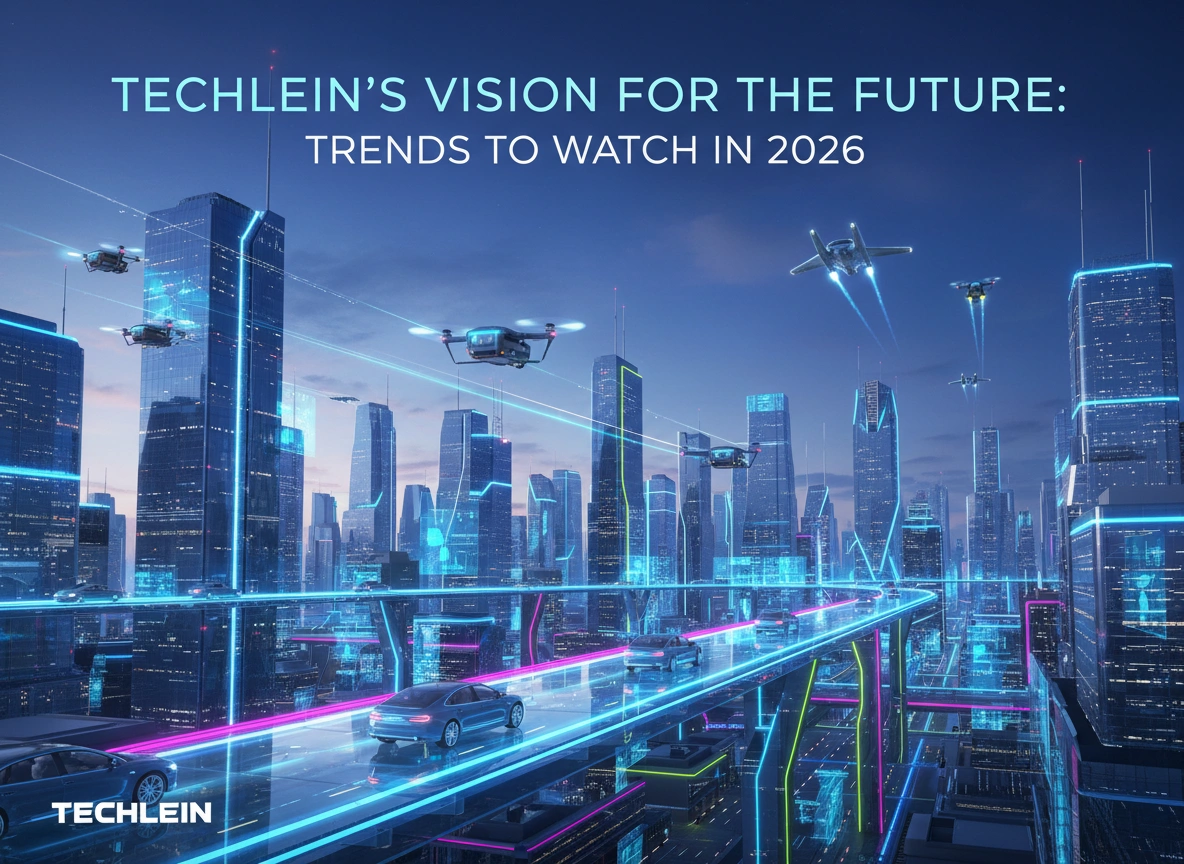
As we look toward the horizon, the pace of technological change continues to accelerate, promising a future that is more connected, intelligent, and sustainable. At Techlein, we dedicate ourselves to not just observing these changes, but to actively shaping them. Our analysis points to 2026 as a pivotal year, where several converging trends will move from a theoretical stage to widespread practical application. This article outlines our vision for the key technological trends that will define the year ahead and beyond.
We will explore significant advancements in artificial intelligence, groundbreaking developments in renewable energy, transformative healthcare innovations, and the continuing evolution of smart cities. These domains are not isolated; their interplay will create a new fabric for society, influencing how industries operate, businesses grow, and we experience our daily lives. Understanding these shifts is crucial for any organization or individual aiming to stay ahead of the curve.
The Next Wave of Artificial Intelligence
Artificial intelligence has already reshaped countless industries, but the advancements slated for 2026 will push its capabilities into new territories. We are moving beyond simple automation and predictive analytics toward more sophisticated, context-aware AI systems that can reason, create, and collaborate with humans in unprecedented ways.
Generative AI Matures into a Business Staple
Generative AI, which captured global attention with its ability to create text, images, and code, will mature significantly. In 2026, we predict its integration into core business workflows will become standard practice. Instead of being a standalone tool, generative AI will be embedded within enterprise resource planning (ERP) systems, customer relationship management (CRM) platforms, and custom business applications.
This deep integration will power hyper-personalized marketing campaigns, automate complex software development cycles, and generate real-time strategic insights from vast datasets. For example, a marketing team could use an AI-powered CRM to not only segment customers but also generate unique email copy, ad visuals, and social media posts for each segment automatically, all while learning from engagement data to improve its next output.
The Rise of Autonomous and Explainable AI
Another key development will be the progress in Autonomous AI. These systems will operate with greater independence to manage complex operations, from supply chain logistics to network security. Imagine an AI that not only detects a cybersecurity threat but also autonomously isolates the affected systems, neutralizes the threat, and repairs the vulnerability without human intervention.
However, with greater autonomy comes a greater need for transparency. This brings us to Explainable AI (XAI). As AI models make more critical decisions in fields like finance and medicine, the “black box” problem becomes a significant liability. XAI development will focus on making AI decision-making processes understandable to humans. In 2026, we expect regulatory bodies to begin mandating XAI for certain high-stakes applications, ensuring that businesses can audit and justify the conclusions their AI systems reach.
Powering Tomorrow: Renewable Energy Breakthroughs
The global imperative to combat climate change is driving rapid innovation in the energy sector. By 2026, several renewable energy technologies will reach a level of maturity that makes them not just viable alternatives to fossil fuels, but superior ones in terms of cost, efficiency, and scalability.
Next-Generation Solar and Energy Storage
Solar power will continue its impressive growth trajectory, but the focus will shift to next-generation photovoltaic technologies. Perovskite solar cells, which are more flexible, lightweight, and efficient than traditional silicon-based cells, will begin commercial deployment. Their versatility will enable them to be integrated into building materials, vehicle surfaces, and even clothing, turning everyday objects into power sources.
The true enabler for a renewable-powered world is energy storage. In 2026, we anticipate major advances in battery technology beyond lithium-ion. Solid-state batteries, which offer higher energy density, faster charging times, and improved safety, will start appearing in electric vehicles and grid-scale storage solutions. This will solve the intermittency problem of solar and wind power, allowing for a stable and reliable energy supply 24/7.
The Decentralization of the Energy Grid
These technological advancements will fuel a fundamental shift from a centralized to a decentralized energy grid. Microgrids—localized grids that can disconnect from the main grid to operate autonomously—will become more common in communities, industrial parks, and university campuses. Powered by local solar, wind, and storage, these microgrids will enhance energy resilience, reduce transmission losses, and empower consumers to become “prosumers” who both produce and consume energy. This distributed model creates a more robust and efficient energy system, less vulnerable to large-scale outages.
The Future of Health: Personalized and Proactive
Healthcare is on the cusp of a revolution driven by technology. The one-size-fits-all approach to medicine will continue to give way to a model that is personalized, predictive, and participatory. In 2026, technology will empower both patients and providers with tools for proactive health management.
AI in Diagnostics and Drug Discovery
AI algorithms will become indispensable partners for clinicians. In medical imaging, AI will be able to detect signs of diseases like cancer or diabetic retinopathy with a speed and accuracy that surpasses human capability. This will lead to earlier diagnoses and better patient outcomes.
Beyond diagnostics, AI will dramatically accelerate the drug discovery process. By simulating molecular interactions and predicting the efficacy of potential compounds, AI can reduce the time and cost of bringing a new drug to market from over a decade to just a few years. In 2026, we expect the first wave of drugs developed primarily through AI-driven research to enter clinical trials.
Wearables and Remote Patient Monitoring
The proliferation of advanced wearable sensors will transform chronic disease management and preventative care. Wearables will evolve from simple fitness trackers to sophisticated medical devices capable of continuously monitoring vital signs like blood pressure, glucose levels, and ECG readings.
This data will stream directly to healthcare providers, enabling remote patient monitoring (RPM) on a massive scale. A physician will be able to track a patient’s condition in real time, receive alerts for any anomalies, and intervene proactively before a serious health event occurs. This shift from reactive to proactive care will reduce hospitalizations and improve the quality of life for millions.
Smart Cities: The Urban Digital Transformation
As the world’s population becomes increasingly urban, technology is essential for making cities more livable, sustainable, and efficient. The concept of the “smart city” will move from pilot projects to large-scale implementation, creating urban environments that are responsive to the needs of their citizens.
Integrated Mobility and Autonomous Transport
Urban mobility will be redefined by integrated platforms and autonomous technology. In 2026, smart city apps will allow residents to plan, book, and pay for trips across multiple modes of transport—public transit, ride-sharing, bike-sharing, and scooters—through a single interface. This seamless experience will encourage a shift away from private car ownership.
Furthermore, autonomous vehicles will begin to play a more significant role in urban logistics and public transport. We predict the deployment of autonomous shuttles on fixed routes in city centers and the use of delivery drones and bots for last-mile package delivery. This will reduce traffic congestion, lower emissions, and improve the efficiency of urban services.
Digital Twins for Urban Planning
A key enabling technology for smart cities is the “digital twin”—a virtual model of a physical asset, process, or system. Cities will use digital twins to create a dynamic, real-time replica of their entire urban infrastructure. Urban planners can use this model to simulate the impact of new developments, test traffic flow solutions, or model the effects of extreme weather events. This data-driven approach will allow city leaders to make more informed decisions, optimize resource allocation, and build more resilient and responsive cities for the future.
Conclusion: Navigating the Future with Techlein
The trends we see emerging for 2026 paint a picture of a future powered by intelligent, sustainable, and connected technologies. From AI that augments human intellect to renewable energy systems that power our world cleanly, these innovations hold immense promise. At Techlein, our vision is to be at the forefront of this transformation, developing the solutions and strategies that help our clients and partners thrive in this new landscape. The journey into 2026 is not just about adopting new technologies; it is about building a better, smarter, and more equitable world for everyone.
